 | The NLP in Education Network October 1998 Issue 2 |
WELCOME to the second edition of 'New Learning'.
If he is indeed wise [the teacher] does not bid you enter the house of his wisdom, but rather leads you to the threshold of your own mind. KAHIL GIBRAN in THE PROPHET
 | JEFF's COLUMNI hope that you enjoy this 2nd Newsletter. My thanks go firstly to Paul Jacobs for putting it together and producing it, then to all the kind people who have contributed, and finally, of course, to you - good reader! - for taking the time to read, and hopefully respond with your comments and ideas. Writing this article has provided an opportunity to reflect on our NLP in Education Network, where we're at and where we're going. So, let's begin with the end in mind. |
Desired State
For me the desired state is a community of people committed to and active in transforming education, having an impact on it so that -
- learning and teaching really are the most enjoyable activities anyone could imagine
- our education system is loved, admired and appreciated by everyone - both those inside and those outside the system
We are about 'making the difference that really makes the difference' and showing people how to do this.
How can we - members of The NLP in Education Network Community - achieve this?
What has recently become clearer is that this involves a two-way process :
- Putting 'NLP' into Education: you will have your own ideas on this - and it's probably what initially drew you to our Network? It was certainly my starting point.
NLP provides a basis for analysing, interpreting and then understanding 'how' - how we ... learn, teach, communicate, lead, manage, influence, .... how we ... write, spell, add up, understand time and place... That is the basis and the power of NLP.
NLP provides a wide range of tools and techniques for (re)discovering these 'hows', bringing the unconscious competence into the conscious realms - and thereby providing the possibility of 1: transferring excellence and 2: more choices for flexibility and change.
- Putting education into NLP: The roots of NLP lie in the world of therapy and is still very much influenced by it. We are drawing knowledge, ideas and applications from the education world and using them to enhance NLP - developing knowledge within NLP and applications of NLP that are appropriate to education.
So, how are we approaching this ? As a start : -
We have a small group that are considering Practitioner and Master Practitioner Certification and will make proposals to various validating bodies - starting with INLPTA. This is not to minimise but support the work already being done by a number of training companies.
Most of you will be aware of 'The NLP Spelling Strategy' which is often used as a starting point when talking to teachers about NLP. We want to encourage NLPers in uncovering more learning and teaching strategies and to make them openly available to both the NLP and education communities. Probably the best people to do this are teachers and students - with the NLP skills of course.
We are about creating a reciprocal partnership between two communities - NLP and Education - at a local, national and even international level. We are about sharing the knowledge, experience and expertise each provides and contributes, about mutual beliefs and values, about helping each have an influence and impact on the other.
Current State
We currently have over 200 'members' in our rapidly growing community - approximately 130 on e-mail and 70 land-mail - with a small but growing number contacting us from abroad.
We held a successful Inaugural Conference last July (see Press Release and Report from Jon Neall below) that was certainly full of energy and enthusiasm, and provided some indicators as to what we are about and how we might move forward.
We have a small 'strategy' group (set up following The Conference) that is becoming an 'activities and actioning group' - ie is putting forward some suggestions that we hope might catch your attention - the aim being to involve and activate you!
We want to support our NLP EdNet community members and help make them more effective. We are looking to get more information about people like yourself - who you are, where you are, what you do, your expertise, knowledge and interests - so that it can be made available to others in our community who might share your dreams and ideals, help you develop your ideas and see them put into practice. On our Web Site you will find a form for you to complete and return.
We are looking to get information from those working in education as to what they really want, what are their major problems and difficulties, if they could really have what they really wanted - what would that be? The idea is to be quick and simple but thorough in obtaining this information - using NLP to get quickly to the point - what do you REALLY want, your REAL Outcomes. It provides an opportunity for you - the individual collectors - to contact people (students, teachers, heads, advisers, etc) and for us as a Network - the compiler - to collect, collate and use this information in all sorts of wonderful ways - within the network (eg to create a guidebook for problem-solving and how NLP can provide solutions, ideas for workshops, etc) and outside the Network (for giving information, getting attention, publicity, etc), ie showing how NLP can make a difference.
We're getting into publishing. 22 people have so far said that they would like to provide a contribution for our first book - with a working title of 'NLP in Education: How do you...?', 'NLP in Education: The Joys of Learning and Teaching' - or something like that!
We're introducing the technology that will make access to information, networking, sharing, finding and providing solutions so much quicker. Tom Maguire has set up a Newsgroup that will provide a super service for those of you who enjoy e-mail discussion groups. We have a wonderful, updated Web Site - which you might even now be accessing!. It will be interactive, and thereby more responsive to your personal requirements, and provide a rich, open interface with the education community. Take a look on http://www.new-oceans.demon.co.uk/ednet/ - if you're not already doing so!
We have an important meeting coming up in mid-October at one of the Government's major Education Agencies, where we'll be discussing NLP and its application to Education with a number of senior professional officers.
In terms of other NLP bodies, we are developing close relationships with ANLP (The UK Association of NLP) who have, for example, offered us a 'guest's chair on their committee, and INLPTA (the International NLP Training Association).
Next Stage(s)
It would seem that there are several major things to do :
- bring us more to life, activate the NLP in Education Community - get you involved, provide you with more support and, where applicable, publicity for what you're doing and want to do, more sharing of ideas, expertise, applications, resources. Our new Web Site will provide one way, a powerful mode of speedy communication - eg for people with common interests who want to share and develop their ideas.
- move into a more 'public' domain - building interest in who we are and what we are doing, publicising our work (and your work), organising activities, starting to provide solutions to previously insoluble problems - showing that using 'NLP' we can really make the difference that makes the difference, and probably more importantly, illustrating precisely how we do this so that you can do it.
- bring in some income to support the work we are doing and want to do. Currently there is none, and especially in this day and age, we're going to be very limited without it. We can probably earn an income through providing services that people like you want, arranging activities and, for example, setting up research - for which we would hope to get funding ...
- As we achieve these goals, we will obviously need more people to take on specific roles and responsibility within The Network.
It's a very exciting time, and we have much to look forward to. I certainly look forward to working with you and supporting the work you are doing.
"We are what we repeatedly do. Excellence, then, is not an act, but a habit" - ARISTOTLE
NLP IN EDUCATION NETWORK - PRESS RELEASE
Have you ever wondered what precisely distinguishes a good learner from a poor one, a good teacher from a poor one, a good head from a poor one, a good school from a poor one? What specifically is the difference that makes the difference? These are the questions which those practising and utilising NLP (Neuro Linguistic Programming) continue to pose. They want to identify what it is that has to be changed to bring about the transformation from poor to good, and from good to excellent.
Imagine a school in which every student and every teacher had all the resources they needed, where there was no failure only feedback, where everyone acknowledged the positive intention underlying every action.
For members of The NLP in Education Network, imagining is a useful and constructive starting point. As a group of educational professionals, with practical experience of both NLP and Education, the objective is to make such a dream come true.
What is NLP? NLP provides a powerful model for answering the following questions - 'How do we make sense of our world?' 'How do we learn?' 'How do we communicate?' 'How do we do things excellently?' 'How do we replicate success?'. It is an on-going process which leads to an increased knowledge and understanding, and practical approaches to learning, teaching, managing, leading ...
NLP is making a major impact on communications, learning and development in the commercial, health and sports sectors. The purpose of The NLP in Education Network is to make this available to the education community through a variety of forums for building and sharing ideas, resources, solutions to problems, and by bringing together the skills and knowledge, the expertise and experience of a wide range of professional people.
Their Web Site and their 'New Learning' Newsletter will be available in September. A number of public events and activities are being arranged and next year will see the first of a series of practical books on NLP in Education that they will be publishing.
Their Inaugural Conference took place on Saturday 11th July 1998 when a group of professionals with a common interest in NLP and Education met together at Oaklands College, St Albans. They considered how best to use and share their experience and expertise to make schools places where healthy self-esteem is encouraged and where teachers are enabled to inspire young people in a love of learning and living.
Every member present felt that the skills and insights provided by NLP could significantly enhance the quality of learning and teaching and the management of our schools. In the first instance members agreed to provide a network for each other to share and encourage good practice. There was also a desire expressed to make NLP more widely known within the teaching profession. Delegates were united by a vision of :
- inspiring young people to a lifelong love of learning
- the contribution that NLP can make to support and enhance the magnificent work already being done by learners, teachers, heads and many other professionals who support them.
One of the presuppositions of NLP is 'If you always do what you've always done, you'll always get what you've always got!'. Perhaps here is a wonderful opportunity to really make a difference?
"The mind is like a clock. It must be wound up daily with good thoughts"
INAUGURAL CONFERENCE: July '98 by Jon Neall
A 16 month-old baby, memories of teaching, and a longing to see the tried and trusted techniques of NLP used in mainstream education, together made up the background to an extraordinary meeting of some 50 teachers, trainers and educational advisers at Oaklands College in St Albans on Saturday 11th July 1998. Most gave up their own time and money in order to take part in the Inaugural Conference of 'The NLP in Education Network'.
The Network and this Conference were the brainchild of Jeff Lewis - the baby's father and a former teacher (and headteacher, teachers' centre leader, adviser and education officer) who has experienced some of what is possible using NLP. Like so many of us involved in state education, we acknowledge and admire the everyday efforts put in by teachers, and yet we long to see greater effectiveness and greater joy within the system. Jeff knew that changing the mainstream education on his own is an impossible task so he began to share his vision with others who had training and experience of NLP. The encouragement he received was enough to call The Conference together.
Inevitably, in such a diverse group, questions arose about NLP itself and its efficacy. What is it? What are you trying to do with it? Is it a cult or something equally sinister? It was valuable to hear such fears expressed and the discussion that followed did much to bring us down to the practical realities of what is it that we want to do and where do we want to go from here?
Subsequent small groups began to explore a range of issues including -
'How can teachers recover the vision that brought them into the profession so that everyday teaching is transformed from the mundane to the inspirational?'.
This group recognised that we may be able to do this by assisting teachers in abandoning their 'tyranny of certainty' (which has left so many scared and damaged in their schooling) and our longing to see schools become places where everyone develops healthy self-esteem.
What strategies do we need to have in place to create the most efficient and effective changes?'
This group considered initial ideas about strategic partnership and relationships - Who we would want to work with as strategic partners - within NLP and within Education? Which groups and individuals would we need to make contact with? What activities would generate the greatest impact? Where we would put our time and energy? This was further explored using the Logical Levels and a Strategy Group was subsequently set up to move ideas and The Network forward.
'Creative Leadership in Education'
This group set out to identify the broad headings around which to group our understandings of creative leadership in the context of education. They considered a number of key aspects including 'Managing versus Leading', 'Modelling Excellence' 'Performance versus Authentic Excellence', 'Risk Taking and Problem Solving' and 'Financial Constraints'.
How ...; How to get attention!
To be successful it is necessary first to get attention, then to maintain interest and secure involvement This group considered a number of factors and approaches to achieve this within the current education context.
Outcome Statements from The Conference
'- to help 'teachers' satiate even more effectively their 'learners' varied and boundless hungers and thirsts for knowledge, skills, useful behaviours and self-esteem, and help the 'learners' to get exactly what they need -' nicely'
'- to help build an education system that fosters curiosity, engenders creativity and develops diversity in which all participants achieve personal and communal fulfillment'
The day was too short to find answers to all our questions, but we did agree that it would be valuable to stay in contact as education professionals, and that we would share and develop ways of using NLP in our schools.
I have never let my schooling interfere with my education.- MARK TWAIN
Education is that which remains after one has forgotten everything learned in school. - ALBERT EINSTEIN
AFTER THOUGHTS - Paul Lowing
What Gumption that Jeff Lewis has sharing his dream and vision with us. A real TOP MAN.Observations during the day: Many wanted more information on how NLP can apply to their subjects or expand it into new areas. Opportunities for a whole host of workshops me thinks!
How about 'Dealing with difficult children' workshop.... 'Presentation' workshops....
'NLP in the Classroom' workshops... 'NLP in the Staffroom' workshops.....
All in all a great day! Great food! Great people! Great food! Great energy and enthusiasm! Great food! Positive Outcomes... and of course Great food!
NLP IN THE CLASSROOM
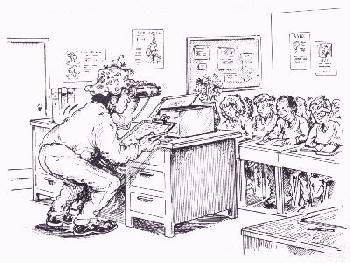
Sensory Acuity Mastery. I wonder if I'm doing it right?
In this issue we have a number of items around techniques and strategies for the classroom. We start with Applications of NLP Meta Programmes by James Lawley, and then three strategies Recalling Maths Equations, Motivation and Creative Writing abstracted from Bernard Cleveland's great book "Master Teaching Techniques".Our first article is a reprint in three parts of an article Published in ANLP Rapport No 37, Autumn 1997. The first part covers introduction to meta programmes and Samenes-Difference. Subsequent parts will address Big Chunk-Small Chunk and Frame of Reference. Thank you to James Lawley for permission to publish it. Meta Programmes in the Classroom by James Lawley
RECALLING MATHS EQUATIONS
This particular learning strategy can be used with adults as well as with younger students. The strategy is diagrammed in this manner:
Have the student select a favourite colour.
- Ve - The student looks at a maths equation that is written down. (Example: 2 + 2 = 4)
- Vr - The student shifts his eyes to his Vr position, sees the equation in his favourite colour and recalls the equation.
- Ke - The student writes down the visualisation.
- Vr - The student shifts his eyes Vr and recalls the equation backwards in his favourite colour. (The purpose of recalling the equation backward is to encourage students to visualise the equation. If this step proves unsatisfactory, eliminate it.)
- Ke - The student writes the equation backward.
- Ve - A list containing the equation plus several similar equations is presented.
- Vr - The student places his eyes in his Vr position and recalls the equation in his favourite colour.
- Ke - The student writes down the correct equation.
- Ve - Another list containing the equation plus several similar equations is presented for completion. Example: 2 + 2 =, 4 + 1 = , 3 + 3 =
- Vr - The student places his eyes in his Vr position and recalls the correct equation in his favourite colour.
- Ke - The student writes the correct equation and its answer on a sheet of paper.
MOTIVATION STRATEGIES
By having material presented in the major sensory systems (V, A, K), students will be motivated automatically by the images, sounds and feelings that such teaching engenders. Also, by reversing students' main learning strategies, motivation occurs automatically.
If their strategy is
V+A+K->Exit, <>then the strategy could be reversed by asking the students how it would feel (K), to listen (A) to and watch (V) a film on a particular subject.
This reversing of the strategy has the effect of bringing students to the beginning of their learning strategy, so that they will be highly motivated to complete the assignment or task. Students can also have their own motivation strategies in non-academic areas elicited and applied to academic areas. For example, student-athletes who excel in a sport and who are highly motivated to play that sport, but who are not motivated to excel in class can have their sports motivation strategy elicited and installed so that academically, they will be more highly motivated. Like the earlier strategies discussed, installation of the motivation strategy would be accomplished through repetition and through anchoring.
CREATIVE WRITING STRATEGY
Writing creatively can be a fun and simple process when this learning strategy is employed:
Vc+Ac+Ki+Ai+Ke->Exit
- Vc - The student places his eyes in his Vc context and thinks about what responses he would like to have from his reader(s). Then he determines what images would get that response.
- Ac - The student shifts his eyes to his Ac position and listens for any sounds or noises connected with the response that he wishes his reader(s) to have. He examines the different aspects of the experience in an effort to hear some meaningful sounds and noises that can generate the desired response.
- Ki - The student shifts his eyes in his K position to sift through the various feelings associated with the experience, so that he can select the most powerful ones to elicit the responses that he seeks from his reader(s).
- Ad - The student places his eyes in his Aid position and talks to himself about what words can best get his desired reader response(s). He can ask himself what different people and/or characters would say about his topic. He can ask himself if his examination of what to say about the topic gives him any ideas of other ways to talk about his topic.
- Ke - The student writes his topic.
WORKSHOPS & EVENTS
4-Day NLP DIPLOMA in Teaching & Learning
6/7, 13/14 Nov at Waltham Forest Education Centre
Contact: Paul Jacobs, NEW OCEANS tel: 01727 869782
THE OPEN UNIVERSITY CREATIVITY IN EDUCATION COMMUNITY - RELATING CRITICAL AND CREATIVE THINKING
Monday 19TH October from 5:30 - 7:30 pm at THE OPEN UNIVERSITY CONFERENCE CENTRE 344 - 354 GRAYS INN ROAD LONDON WC1X 8BP
David S. Martin, Professor of Education at Gallaudet University in Washington, DC, will lead a seminar on principles of critical thinking that relate to the enhancement of creativity; included will be topics related to multiple intelligences, teaching for thinking, and creative problem-solving strategies.
The seminar will cost £5 (£2 unwaged) to cover expenses. Cheques shouldbe made payable to The Open University.
Entry by advance booking: contact Bronwen Sharp at The Open UniversitySchool of Education, Walton Hall, Milton Keynes, MK7 6AA. Telephone:01908 652894
NLP Practitioner Course for Teaching & Learning
10 Weekends starting 26/27th September in Ealing, London
Contact Cricket Kemp,
NLP Northeast, Bongate Mill Farmhouse, Mill Hill, Appleby in Westmorland, Cumbria CA16 6UR
Tel: 01768 351934

NLP Education Network
Rediscover the Joys of teaching and learning
For more information on NLP Education Network contact
- Jeff Lewis 24 Oaklands Lane Smallford St Albans Herts AL4 0HR :
- Tel: 01727 856200 Fax: 01727 842181
- Email: [email protected] Website http://www.new-oceans.co.uk